

How people learn
A short list of what works, and how DuckyHelper does each one.
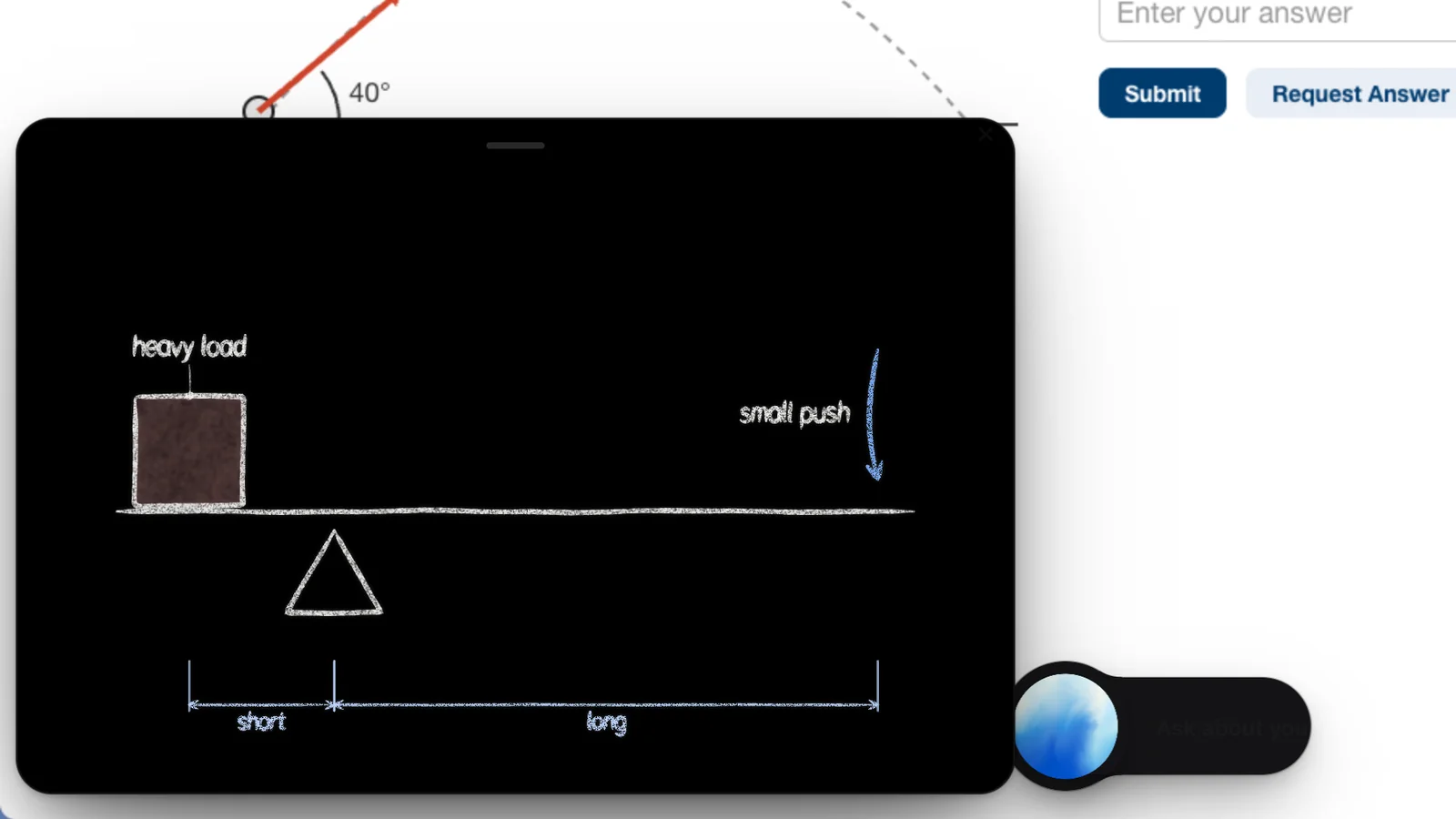
 It sketches the lever and measures each side while it talks.
Decades of research agree on a short list of things that help people learn: a tutor who guides, worked examples, pictures with words, quizzing yourself, spacing and mixing practice, explaining in your own words and quick feedback. Here are twelve, each with the papers behind it and what DuckyHelper does because of it.
Twelve principles
Teach one on one
OpenGuide, don't hand over answers
OpenJust enough help
OpenShow a worked example first
OpenDraw it as you explain
OpenQuiz, don't re-read
OpenSpace it out
OpenMix it up
OpenExplain it back in your own words
OpenFeedback right away, on the step
OpenKeep the learner doing, not watching
OpenWhat the evidence says about AI tutors
What the evidence says about AI tutors
Open
The evidence in one line each
| Principle | What the research found | What DuckyHelper does |
|---|---|---|
| Teach one on one | Tutored students scored about two standard deviations above a regular class (Bloom, 1984). | Live voice teaching for one learner. |
| Guide, don't hand over answers | Unguarded AI help cut exam grades 17%; safeguards largely fixed it (Bastani et al., 2025). | Try first, hints before answers. |
| Just enough help | Tutors handle what is beyond the learner and leave the rest to them (Wood, Bruner and Ross, 1976). | Hints one at a time, worked steps that stop where you are. |
| Show a worked example first | Worked examples beat problem solving for beginners (Sweller and Cooper, 1985). | Worked steps, one move each. |
| Draw it as you explain | Words with pictures beat words alone (Mayer and Moreno, 2003). | Drawing on your screen and on the blackboard. |
| Quiz, don't re-read | A practice test beat re-reading a week later, 56% to 42% (Roediger and Karpicke, 2006). | Check questions and quizzes. |
| Space it out | Spacing helps across 317 experiments (Cepeda et al., 2006). | Flashcards on a spaced schedule. |
| Mix it up | Mixed math practice did far better a week later (Rohrer and Taylor, 2007). | Reviews that mix your topics. |
| Explain it back | Prompting students to self-explain improved learning (Chi et al., 1994). | Asks what you think, checks after each step. |
| Feedback right away, on the step | Feedback about the task helps; about the self, it can hurt (Kluger and DeNisi, 1996). | Not quite and why, the first wrong line. |
| Keep the learner doing | Active learning raised exam performance across 225 studies (Freeman et al., 2014). | Simulations you run, quizzes you answer, steps you do yourself. |
| What the evidence says about AI tutors | Built-to-teach AI tutors showed gains in early trials; plain answers hurt. | It asks you back instead of handing over the answer. |
Every number belongs to the study cited beside it. DuckyHelper has not been tested in a study like these.
What these pages do not claim These studies tested other people, other schools and other tools. DuckyHelper has not been tested in a study like these, so none of these results are DuckyHelper's results. They are the reasons behind how it teaches.
Questions
What are the most effective ways to study?
A large review by Dunlosky et al. (2013) rated practice testing and spaced practice as the most useful of ten common techniques. Re-reading and highlighting rated low.
Which principle matters most for an AI tutor?
Not handing over answers. Bastani et al. (2025) found a plain AI chat hurt exam results, while a version built to give hints mostly did not.
Does DuckyHelper follow all twelve principles?
It is built around all twelve, and each page says what it does today. Where a principle is only partly covered, such as interleaving or explaining it back, the page says so plainly.
Do anything
Ask it a question or hand it a job, in any app.





Doing jobs for you is in the Mac app. Asking works on Mac, Windows and Linux.